


MINNEAPOLIS — Minneapolis Heart Institute Foundation enrolled the first patient in the OPTIMAL P5 trial comparing two cardiovascular imaging approaches, using either computed tomography (CT) or intravascular ultrasound (IVUS), to guide the treatment strategy for severely calcified coronary artery disease. The first case was led by Yader Sandoval, MD, Interventional Cardiologist, Site Principal Investigator and Co-Chair of MHIF’s Center for Coronary Artery Disease (CCAD) and performed with Emmanouil S. Brilakis, MD, PhD, CCAD’s Chair and Allina Health Minneapolis Health Institute’s Director of the Center for Complex Coronary Interventions.
OPTIMAL P5 is an international, randomized clinical trial comparing CT-guided versus IVUS-guided calcium-management strategies in patients undergoing percutaneous coronary intervention (PCI) for severely calcified coronary artery disease. The trial is led by Carlos Collet, MD, PhD, Director of Cardiovascular Imaging, Physiology, and Translational Therapeutics at the Cardiovascular Research Foundation (CRF), who serves as Global Principal Investigator for both the P4 (NCT05253677) and OPTIMAL P5 (NCT07286578) randomized clinical trials. The global co-PI for the OPTIMAL Trial is James Spratt, MD, PhD at St. George’s University NHS Trust, London, UK. CRF also serves as the imaging core laboratory for the trial, providing centralized CT analysis to support consistent, standardized assessment of coronary calcification across participating sites.
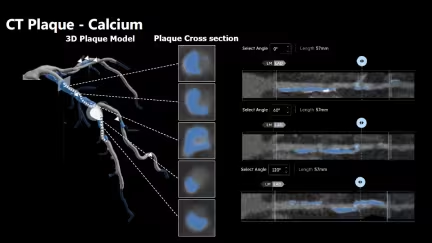
The trial addresses one of the most persistent technical challenges in interventional cardiology: severe coronary calcification, which can limit optimal stent expansion. Participants with confirmed severe coronary calcification are randomized to a CT-guided or an IVUS-guided strategy to inform decisions on lesion preparation and calcium modification before stent implantation. The CT-guided arm uses pre-procedural coronary CT to characterize calcified plaque, including the novel concept of calcium density, and anticipate the need for calcium-modification therapy. The IVUS-guided arm relies on intraprocedural ultrasound assessment to direct treatment in real time. The trial will assess whether the CT-guided approach can support more individualized, efficient, and effective PCI planning in this population.
Dr. Sandoval and MHIF's CCAD team bring substantial experience to OPTIMAL P5: the site was the highest-enrolling site in the U.S. for the preceding P4 trial, with results expected later this year at the Transcatheter Cardiovascular Therapeutics (TCT) Conference in San Diego and is also among the highest-enrolling sites in the NAVIGATE-PCI registry (NCT07479433), a multicenter registry of CT-guided PCI. MHIF’s CCAD team is also leading the investigator-initiated CT-PLAN PCI trial (NCT07691502), further establishing leadership in this growing field of using coronary CT for PCI planning. MHIF's participation in OPTIMAL P5 extends its broader work in advanced coronary imaging and image-guided PCI research, and the trial may help clarify the role of noninvasive coronary CT in planning PCI for patients with complex, severely calcified coronary artery disease.
"Being the first U.S. site activated, and enrolling the first U.S. patient, in OPTIMAL P5 is a significant milestone for our team," said Dr. Sandoval. "Severe coronary calcification remains one of the most important challenges to delivering optimal PCI, and this trial will help us understand whether CT can provide actionable information before the procedure to better tailor calcium-management strategy for each patient. We are excited to continue our partnership with Dr. Collet and his research team across the P4 and OPTIMAL P5 trials, and to learn how we can leverage CT to improve care and outcomes for patients undergoing PCI, particularly those with severe calcification who represent a complex patient subset."
"Following the pivotal P4 trial, which we anticipate results from later this year, OPTIMAL P5 is the next step in evaluating how coronary CT can inform PCI strategy," said Dr. Collet, Director of Cardiovascular Imaging, Physiology, and Translational Therapeutics at CRF. "By studying patients with severely calcified coronary lesions, we aim to determine whether CT-based planning can provide a reliable roadmap for selecting an appropriate calcium-management approach before PCI begins. CT allows us to characterize calcium density and distribution non-invasively, which may help identify, ahead of time, which patients are likely to require advanced calcium modification to achieve optimal stent expansion."
"MHIF is proud to be the first activated U.S. site in this important international trial," said Dr. Brilakis. "This achievement reflects our ability to translate emerging cardiovascular science into carefully conducted clinical research that gives patients access to innovative approaches to complex coronary disease."
"CRF is pleased to partner with MHIF as the first activated U.S. site for OPTIMAL P5," CRF indicated. "Collaborations like this one are essential to advancing our understanding of image-guided PCI and generating the evidence needed to improve outcomes for patients with complex coronary disease."
About Minneapolis Heart Institute Foundation
Minneapolis Heart Institute Foundation (MHIF) is a nonprofit cardiovascular research and education organization dedicated to improving the prevention, diagnosis, and treatment of heart and vascular disease for patients around the world. MHIF is a recognized leader across all specialties of heart and vascular research. Each year, MHIF leads more than 220 research studies with more than 2,200 patients and publishes more than 250 articles in top-tier medical journals to share learnings from research.
About Cardiovascular Research Foundation
The Cardiovascular Research Foundation (CRF) is a 501(c)(3) nonprofit organization dedicated to improving survival and quality of life for people with heart and vascular disease. Founded in 1990, CRF drives medical innovation, conducts major clinical trials, and provides global educational symposia in interventional cardiovascular medicine. CRF serves as the imaging core laboratory for OPTIMAL P5, and the trial is led by Carlos Collet, MD, PhD, Director of Cardiovascular Imaging, Physiology, and Translational Therapeutics at CRF.
The OPTIMAL Trial is sponsored by the Fundación EPIC, Leon, Spain, through unrestricted research grants from Heartflow, Inc., and Shockwave, Medical, Inc., USA.


